"This is not democracy" | Bernard Kouchner on How to Support a Revolution | Google Zeitgeist
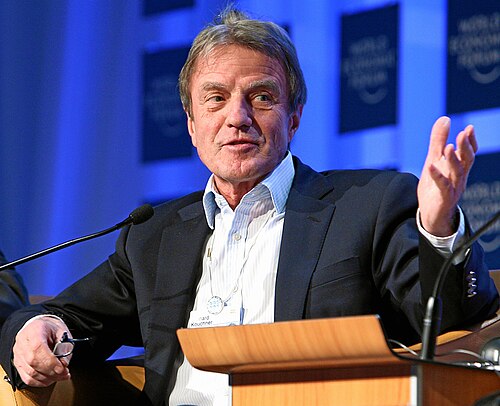 Bernard Kouchner
Transcription Whisper (large-v3), avec identification des locuteurs. À recouper avec la source d'origine.
Analyse automatique
Générée par IA — peut contenir des erreurs. Méthodologie
Chapitres
Répartition du ton (temps de parole politique)
Propositif 60 %Attaque 10 %Défensif 30 %
Questions et réponses
Taux de réponse directe : 100 % (directe = 1, partielle = 0,5, éludée = 0)
- 0:08OuverteRéponse directe
What kind of an epoch is this we are living through with all that happening?
- 0:14OuverteRéponse directe
They were all young.
- 1:02OuverteRéponse directe
Youth is the coordinating factor, it's the common factor.
- 1:08RelanceRéponse directe
Do you think we're going through something different this time?
- 2:29OuverteRéponse directe
How difficult is it for those in power to experience what is really going on?
- 3:51ComplaisanteRéponse directe
But it's certainly for the better.
Affirmations vérifiables (citations exactes)
- 0:26Invité politiqueFait
« Not only it was a revolution because of Twitter, because of Google, but it was a young revolution. »
- 0:42Invité politiqueFait
« they start to stop supporting dictatorship. »
- 1:33Invité politiqueFait
« because they were able to know what happened somewhere else, in a close country or very far. »
- 1:55Invité politiqueFait
« The communist revolution was, in that time, 1917, a sort of hope, but step by step it became an horrible situation. »
- 2:52Invité politiqueFait
« This is very difficult, because despite of the so-called immediate future, we all know that it is impossible to judge and to know what's going on before some years. »
- 3:11Invité politiqueFait
« It was for freedom. It was for more freedom that they were in the street and that they revolted. »
- 4:36Invité politiqueFait
« The youngsters who are in the street were not following anybody. They were following their deep sense of coming democracy. »
- 4:57Invité politiqueFait
« Why now? Because of the sacrifice of this young Tunisian who burned himself. »
- 5:27Invité politiqueFait
« The experts are very good in expertise, but not in politics. »
- 6:05Invité politiqueFait
« not to stop pushing in the direction of human rights, rule of law. »
- 6:14Invité politiqueFait
« We were not attentive and precisely we were not supporting enough human rights under dictatorship. »
- 7:41Invité politiqueFait
« Democracy is also by advance to accept that your enemies will win. Not only your friends. »
- 8:53Invité politiqueFait
« Yes. Because we were not expecting that because we were used to these people accepting dictatorship and it was feeding extremism in that time. »
- 9:51Invité politiqueFait
« It reminds us the world before the Second World War, the time of nationalism and fascism. »
- 11:02Invité politiqueFait
« It was, I mean, the expression of... But Greece itself you know, Greece voted left. This is not the same thing. »
Temps de parole
- Bernard Kouchner68 %
- Présentateur32 %
≈ 0 interruption / 10 min (chevauchements et interjections détectés).
Modèle mistral-small-latest · prompt v1· les citations sont vérifiées mot pour mot dans le transcript ; le taux de réponse directe est calculé à partir des verdicts question par question. Aucun label idéologique n'est produit.
What is your best guess to the answer to the question, what kind of an epoch is this we are living through with all that happening? They were all young.
Well, you have seen, I mean, Plastarie or somewhere else, they were all young. Not only it was a revolution because of Twitter, because of Google, but it was a young revolution. And it was really unprevisible, like it is unprevisible now, but they start to stop supporting dictatorship. And they were young and they were absolutely enthusiastic and brave and courageous. So that's the idea, the general idea, because the nations were different, the countries were different, the people were different, but the movement was...
Youth is the coordinating factor, it's the common factor. But we've had revolutions in your lifetime. We all remember 1989 when youth played a part, but in a way the inheritors of power were often the old, the hierarchical structures didn't break. Do you think we're going through something different this time? Yes, because of the electronic time,
because they were able to know what happened somewhere else, in a close country or very far. During this time, it happens in Burma, in Myanmar, and nobody was talking about revolution. It was a big change. And so all your examples are, of course, it's very different one from the other. The communist revolution was, in that time, 1917, a sort of hope, but step by step it became an horrible situation. So sometimes we don't know. So there is an unknown world facing us after this Arab Spring. And I underlined another time, all the countries are not the same. I mean, it was not the same situation in Tunisia than in Egypt, in Yemen, than in Morocco. And something is uniting all people.
This is hope for the future. How difficult is it for those in power, in the political and business elite, to experience what is really going on? Are they, I mean, we saw, of course, the leaden-footed dictatorships of the Middle East fail, and still fail, to respond. But for people who call themselves Democrats, how hard is it to keep up with what the young and what the masses of these countries actually want?
This is very difficult, because despite of the so-called immediate future, we all know that it is impossible to judge and to know what's going on before some years. and sometimes one or two generations. But we know perfectly that it was for freedom. It was for more freedom that they were in the street and that they revolted. So we'll see. You know, there is a difference. The speed is different in between the press and the electronic time and the reality. The reality of politics, the reality of the people is completely different. It takes not only overnight to change dictatorship in democracy. Certainly not. It takes another time. I repeat what I've said. Generation.
But it's certainly for the better. This, too, was also a feature of previous revolutions. The mismatch between official time and the time on the streets. But isn't there a problem here? In the sense that, you know, when you meet some of these activists, some of the university-educated people I've met in Cairo, some of the people in the Occupy movement in America, they are almost like social entrepreneurs. They are not passive masses. They can make things happen. They want this to happen. They know how to do it. They have the technological expertise often. And so maybe that excuse doesn't wash anymore, the idea that everything takes a long time. Maybe it just doesn't wash.
But we are not talking about the same people. The youngsters who are in the street were not following anybody. They were following their deep sense of coming democracy. They were rebel against dictatorship. And they supported dictatorship, not the young people, because they were two young. For 40 years. Why now? Because of the sacrifice of this young Tunisian who burned himself. And because also they, this is impossible to say it was time. impossible because nobody, neither one expert, told us in that time that we were coming. And the Arab Spring was blowing. Not at all.
And it was the same time before the, it was the same thing before the, the falling of the Berlin Wall or the end of communism. The experts are very good in expertise, but not in politics.
Yeah. So what is the challenge for statecraft? What are the challenges for the major powers who are going to have to pick up the pieces when things go wrong? We already saw in Libya, we will probably see something in Syria. What would you say for politicians is the key thing they have to learn from what's happened so far?
I repeat, in Libya, this is not the same situation than now in Yemen. And in Gaza, it's not the same situation like in Egypt, etc. But the main thing is certainly not to stop pushing in the direction of human rights, rule of law. We were not attentive and precisely we were not supporting enough human rights under dictatorship. And there is a big, a good way to judge or to have a real, this is the women condition. women condition that must not be abandoned because of the, I mean, the movement in the streets on the country. It must be looked at very precisely. But otherwise, it will take another time. We don't know about the coming presidential election in Egypt. We'll see.
But something also is different. When we were meeting, you and me, the people, the intellectuals in New York on somewhere else, they were more extremist than they are now. And especially the Muslim brothers. Especially the Muslim brothers, they have changed because the reality changed them. So extremists, Salafists, etc., we don't know. But I remember something precisely because I was a member of the government under President Mitterrand. And we had in 92 to face the Algerian election. And the Algerian election, the first round was precisely the success of the Muslim brothers, so-called. The fist. And we stopped. We. Not we, the Algerian. But we were supporting. Not me.
Because something must be understood. Democracy is also by advance to accept that your enemies will win. Not only your friends. And it was the case in Algeria as the extremists or so-called extremists were on the verge of having a power, getting the power on the second round, we suppressed the second round. It must not be done another time.
You argued against it at the time where you no think that history vindicates you and this just is not an option. Yes. Otherwise, we don't have to talk
about democracy. If democracy is reserved to our friends or the people who are sharing our opinion, this is not democracy.
We saw a whole montage of events there in the introductory film. Right back to 1789 in your country, class was always an issue in the European revolutions. Class has been an issue in Tunisia, certainly, and in Egypt. Do you think, however, that these revolutions that we are living through are in some way fundamentally different from everything else we've lived through? Is class gone now? Social status gone?
Yes. Because we were not expecting that because we were used to these people accepting dictatorship and it was feeding extremism in that time, you know? But, yes, this is very different. First, this is in the Arab world and our Arab friends were known, badly known, by their acceptance of this dictatorship. But it was not true. We were absolutely not enough attentive to their behavior. And, second, you know, this is very dangerous because extremism must, should be, would be, eventually, coming out of this demonstration. so, this is very dangerous. Nationalism is hidden, certainly, and extremism and nationalism going together.
It reminds us the world before the Second World War, the time of nationalism and fascism. I don't want to compare. This is not the same situation, but we have to be very cautious about that. Is it possible in our country we also have not to interfere too much? So, that's why I'm talking about an unknown world
facing us. Those of you who are lucky enough to be able to watch live and unleashed as it goes out Fox News and who were also lucky enough to be able to watch Glenn Beck in his prime on that channel may remember Glenn doing a famous chalkboard experience where he places a series of stickers of explosions which go on Tunisia, Egypt and then the explosion crosses the Mediterranean to Greece, Italy, Spain and eventually Europe is consumed by the same revolutionary conflagration. Now, do you buy that? No. Why not? Because it was a farce.
It was, I mean, the expression of... But Greece itself you know, Greece voted left. This is not the same thing. The result of that, not the result. I mean, to summarize, we are in a very difficult period for Europe but Europe is a solution not a problem and Europe, it's made of people, nations, they were fighting each other. We fought each other during centuries and centuries and this is the beginning of something else despite of the crisis. The crisis is economical more than political. No, the crisis is political.
Europe is a solution and certainly, this, I don't know when, in 50 years, 40 years, I believe that all these people on the southern part of Mediterranean and certainly going to the Arab world entirely, they will try to be together and to join a sort of union, a union for Mediterranean.
One of the parallels people have drawn is with 1848 which of course started in Paris and spread through the capitals of Europe. Within two or three years of 1848, the revolution was over but economic stability and growth were not and in some senses dictators, Napoleon III in your country, delivered modernity. What happens if the people who will rule Egypt and Tunisia and eventually Syria, what happens if they don't deliver modernity and growth? Because they were coming from
the nightmare of dictatorship and the people from central Europe were also coming from a nightmare but we were there to support, to accept, it was not easy, to let them come in the European Union as a sort of not a reward but partly a reward because they were out of communism and also to be partners and we have to certainly facing the Arab Spring, we have to be partners after with them to offer them projects to offer to be with them in working together not as post-colonialist people
but as friends. Before we finish, I invite some of the other speakers forward. What is the thing right now you are the most worried about in this situation? I told you about the condition
of women and I hope that it will be not a delusion because I insist it's easy to talk about coming democracy, to ask for democracy but to realize democracy takes years and years and we don't have to be impatient too much. Bernard Kushner, thank you.